Friday, July 17, 2026 — less than three weeks before the August 3 Trade Deadline.
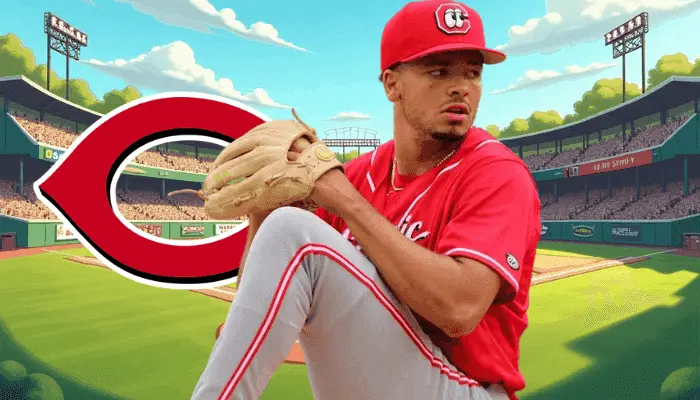
The Cincinnati Reds spent Thursday doing something small-market clubs rarely do: handing out the largest guarantee in baseball history to a pitcher who hasn’t reached arbitration. By Friday morning, the industry had already moved on to the follow-up question — if Chase Burns is the future, what happens to Hunter Greene?
The Burns Deal, in Full
Burns and the Reds agreed to a seven-year, $105 million extension, a deal that begins in 2027 and runs through 2033 with no club options and no deferred money. It buys out two of his free-agent years — he had been on track to hit the open market after 2031 — and it stands as the largest contract ever given to a pitcher who has yet to reach arbitration.
The structure is a classic small-market ramp: a $2 million signing bonus, then $2.5 million in 2027, $8 million in 2028, $12.5 million in 2029, $15 million in 2030, $17 million in 2031, $23 million in 2032 and $25 million in 2033. Cincinnati pays almost nothing in the near term and absorbs the real money only once Burns would have been expensive anyway.
He has earned it. The 23-year-old went into the All-Star break 11-1 with a 2.54 ERA and 118 strikeouts across 102 2/3 innings, completing at least five innings in all 18 of his starts. His fastball averages nearly 98 mph — the second-hardest of any big league starter — and hitters have managed just a .206 average against him. The No. 2 overall pick out of Wake Forest in 2024, he reached the majors less than a year after signing and made his first All-Star team this week.
Which Brings Us to Hunter Greene
Here is the wrinkle. Cincinnati now has two former No. 2 overall picks locked up long term. Greene signed a six-year, $53 million extension back in 2023 that runs through 2028 and carries a $21 million club option for 2029.
That should be a luxury. Instead, at 43-52 and last in the NL Central, it looks like leverage.
The Reds are widely expected to sell over the next three weeks, and the problem is that none of their obvious trade chips project to bring back anything meaningful. Greene is the exception. Dangling him would accomplish two things at once: clear payroll and import the kind of young talent a rebuilding roster actually needs.
The Case For — and Against — Moving Him
Why a contender would pay up: Greene is 26 with genuine ace stuff. Across 2024-25 he posted a 2.76 ERA with 10.5 strikeouts per nine innings. He is signed at a rate that looks like a bargain in the current market, with multiple years of control attached — the profile teams fight hardest over in July.
Why Cincinnati might hold: injuries have shadowed his career, and 2026 has been no different. He missed the first three months after March surgery to remove bone chips from his elbow, and his July 4 return was a mess, eight runs allowed. Then, in his very next outing, he struck out 12 Cubs over seven scoreless innings. That is the whole Hunter Greene experience in two starts.
The market context matters too. If Detroit hangs on to Tarik Skubal, Minnesota keeps Joe Ryan and Boston holds Sonny Gray — all plausible, since each club is hovering near contention — then Greene becomes the most interesting starting pitcher available, and the bidding gets serious in a hurry.
Reading the Room
Nothing about the Burns extension forces Cincinnati’s hand. A healthy Greene alongside Burns is a legitimate top two, and manager Terry Francona has a young roster with an average age of 28.5. The Reds could reasonably decide that 2027 starts now and keep both.
But front offices don’t hand out franchise-record guarantees in a vacuum. Locking up the 23-year-old you control through 2033 while shopping the 26-year-old you control through 2028 is a coherent plan, not a contradiction — and Cincinnati has a long institutional memory of what long-term pitcher deals can become. Homer Bailey is still a name people say out loud in that clubhouse.
Three weeks to the deadline. Cincinnati just told us who it is building around. The next move will tell us who it is willing to build with.








Add a comment