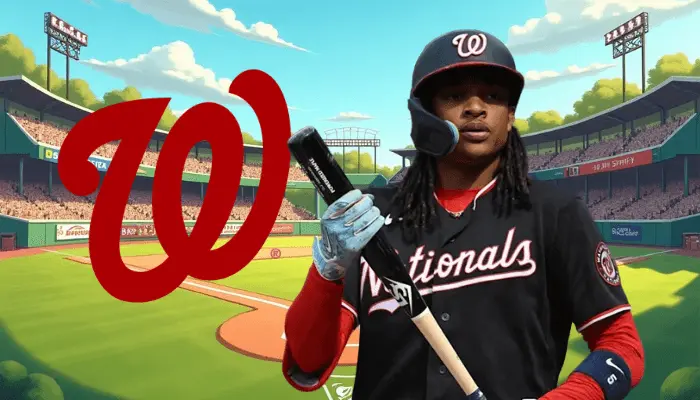
Tuesday, August 18, 2026 — Washington announced a position change that reshapes its most valuable trade asset.
Nationals manager Blake Butera confirmed this week that CJ Abrams is moving off shortstop. Nasim Nuñez becomes the regular there; Abrams shifts gradually to second base, with occasional starts at his old position.
Reporting out of D.C. indicates Abrams isn’t thrilled about it. He shouldn’t be — and every front office that has called about him just quietly recalculated.
Why Washington Did It
The bat has never been the question. Abrams entered August hitting .286 with 28 home runs, 85 RBIs and 20 steals, and FanGraphs rates him the fourth most productive shortstop in baseball this season. Baseball-Reference has the Nationals third among all clubs in production from the position.
The glove is a different story. Since 2022, Abrams ranks last in the majors at minus-57 Outs Above Average. Not last among shortstops — last, period. That number has been the elephant in every trade conversation for two years.
Washington has also stocked its system with high-end infield prospects, which makes moving Abrams down the defensive spectrum a logical organizational choice rather than a punishment.
What It Does to His Value
It lowers it. There’s no diplomatic way around that.
An elite offensive shortstop is one of the scarcest assets in baseball. An elite offensive second baseman is valuable, but the acquiring team can no longer tell itself the defense might stabilize. Washington has just publicly conceded it won’t.
The counterargument is that clubs already knew. The Brewers and Yankees showed interest before the deadline, per The Athletic’s Spencer Nusbaum and Will Sammon, and every analytics department has seen the OAA figures. What changes is the negotiating posture: a buyer can now point at the Nationals’ own decision as evidence.
The Clock Is the Real Issue
Abrams reaches free agency after 2028. Washington controls him for this season and two more, and his arbitration salary rises every winter. As MLB Trade Rumors put it plainly: as the control window shrinks and the salary climbs, the return shrinks with it.
That leaves Paul Toboni with a binary choice this offseason — extend him or move him. Standing pat is the one option that guarantees a worse outcome later.
Toboni has been consistent publicly, saying last winter that “it’s not like we are calling other teams and looking to trade CJ,” while adding the club will always listen. Nusbaum and Sammon reported the same posture in July: Washington isn’t shopping him, but will hear offers.
The Fits
Brewers. They balked at Washington’s asking price in offseason talks and are expected to circle back. The fit is awkward — Brice Turang is entrenched at second through 2029, Cooper Pratt is already in the majors on an eight-year extension, and Jesús Made is MLB Pipeline’s No. 1 overall prospect. Third base is the plausible landing spot. Washington would almost certainly ask for Made first, and Milwaukee would almost certainly say no.
Yankees. They inquired in July and ended up with Luis García Jr. instead. George Lombard Jr. has since claimed shortstop, which makes an Abrams-at-second scenario more coherent, not less.
Red Sox. Linked repeatedly. Boston wants a shortstop, though — and Abrams is now explicitly not one.
The Read
The position change reads like a club making an honest evaluation rather than a club preparing a sale. But the two aren’t mutually exclusive. Moving Abrams to second now, letting him log innings there, and then marketing him in November as a proven second baseman with two years of control is a perfectly rational sequence.
It costs some value. It removes the biggest objection buyers have.




Add a comment