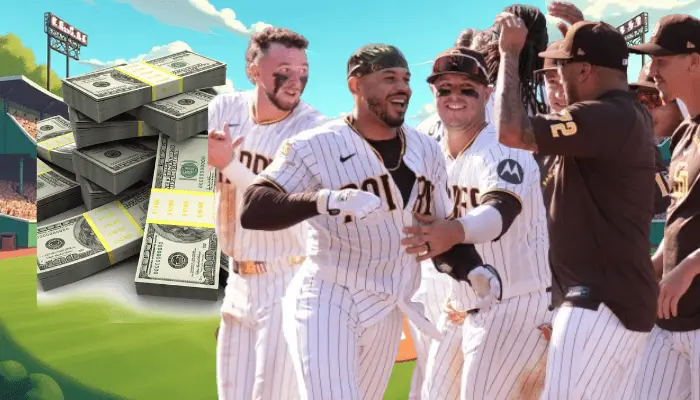
The most consequential transaction in baseball this week didn’t involve a player. José E. Feliciano and Kwanza Jones are now the owners of the San Diego Padres, at a valuation of $3.9 billion — and every rumor about that roster over the next six months runs through what they decide to do with the payroll.
The Deal
The price shatters the previous MLB record of $2.42 billion, set when Steve Cohen bought the Mets in 2020. It also dwarfs the $800 million the Seidler-Fowler group paid for the Padres in 2012 — a fourteen-year appreciation curve that explains a great deal about why franchise valuations dominate the current labor fight.
Feliciano will serve as the club’s control person. He and Jones are acquiring more than 40 percent of the franchise, with minority partners including Joey and Jesse Buss. The closing is expected within days, and the pair will be formally introduced at Petco Park on August 24.
Crucially for the baseball operation: Erik Greupner remains CEO, and A.J. Preller stays on as president of baseball operations.
Who Feliciano Is
He co-founded Clearlake Capital in 2006, a private equity firm now managing more than $90 billion. Clearlake supplied a large portion of the funding for the $3.16 billion purchase of Chelsea in 2022. Feliciano came close to buying a minority stake in the Chargers two years ago and bid unsuccessfully for the Broncos in 2022.
Worth noting: MLB restricts private equity ownership to 30 percent of a franchise, and Feliciano and Jones are funding their stakes individually rather than through Clearlake.
Why This Matters to the Trade Market
Rewind to July 20. Kevin Acee of the San Diego Union-Tribune reported the Padres had “not ruled out anything” ahead of the deadline — including moving Mason Miller. One concept discussed internally was attaching Miller to Xander Bogaerts to get a rival to absorb the roughly $175 million still owed on that contract from 2027 onward.
A specific uncertainty hung over all of it: nobody outside the building knew whether the incoming ownership group would ask Preller to cut payroll.
Preller answered by going the other direction, trading three of his top nine prospects for Casey Mize and Robbie Ray. San Diego has since surged into the second National League Wild Card spot.
The Ledger the New Owners Inherit
It is not a light one:
- Fernando Tatis Jr. — roughly $266 million from 2027 through 2034
- Manny Machado — roughly $245 million from 2027 through 2033
- Xander Bogaerts — roughly $175 million from 2027 onward, with a full no-trade clause
- Jackson Merrill — roughly $124 million from 2027 through 2034
- Jake Cronenworth — roughly $48 million from 2027 through 2030
Alongside that: a roster with holes in the rotation, the outfield and behind the plate, and the best reliever in baseball under control through 2029.
The Question for the Winter
Peter Seidler ran high payrolls and was openly willing to lose money to win. Whether that philosophy survives an ownership change to a private equity founder is the single biggest unknown in the National League this offseason.
If the new group spends like Seidler did, San Diego enters the winter as a buyer and Mason Miller stays. If it wants cost discipline, Miller becomes the most valuable trade chip in the sport — a controllable elite closer whose value could be converted into the multiple young pieces this roster needs, all at once.
CBS Sports already ranks Miller seventh among early offseason trade candidates, with the Cubs, Dodgers and Yankees as plausible destinations.
One More Layer
All of this collides with the CBA. The current agreement expires December 1, a lockout is expected, and MLB has proposed a $245.3 million salary cap for 2027. A new ownership group has no incentive to make franchise-altering financial decisions until it knows what the rules will be.
Which suggests San Diego’s winter may be quiet by necessity rather than choice — and that the real reckoning with that payroll arrives later than anyone would like.





Add a comment