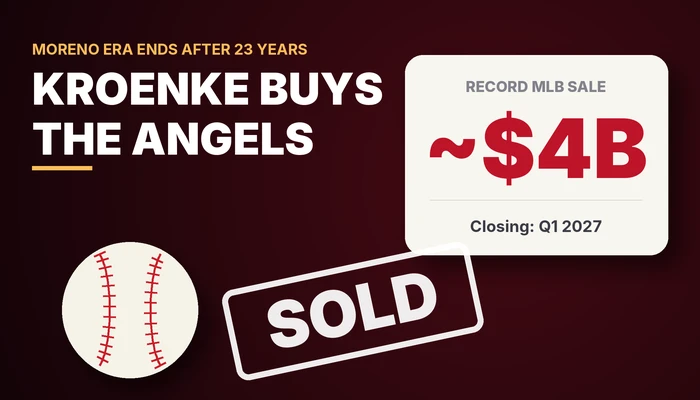
Tuesday, September 1, 2026 — after 23 years, 11 straight losing seasons and countless “Sell the team” chants, Arte Moreno finally did.
Arte Moreno has agreed to sell a controlling interest in the Los Angeles Angels to Stan Kroenke. The deal, announced Tuesday, runs through Kroenke Sports & Entertainment — the company behind the Rams, Nuggets, Avalanche, Rapids and Arsenal — and is expected to close in the first quarter of 2027, pending MLB approval.
The valuation is reported at roughly $4 billion, which would top the $3.9 billion record set by the Padres’ sale earlier this year. Neither side disclosed the exact price.
The End of the Moreno Era
Moreno bought the Angels from Disney in 2003, months after the franchise’s only World Series title, and became the first Latino majority owner in the major leagues. The early years were a success by almost any measure: Vladimir Guerrero and Bartolo Colón arrived, beer prices dropped, the club won the AL West five times between 2004 and 2009, and attendance topped 3 million every season from 2003 through 2019.
Then the results stopped. The Angels have reached the postseason once since 2010 and have now clinched an 11th consecutive losing season. They squandered the primes of Mike Trout and Shohei Ohtani. A 2011 TV deal with Fox, worth $3 billion over 20 years, funded headline signings — Albert Pujols, Josh Hamilton, C.J. Wilson — that aged badly. Critics described an owner too involved in baseball decisions and too reluctant to invest in the infrastructure that modern front offices rely on.
Moreno tried to sell once before, in August 2022, then pulled the team off the market nine months later. This time, it’s done.
Why the Timing Is Surprising
Most people around the sport expected Moreno to sell eventually — but not yet. The working assumption was that he would wait until the new collective bargaining agreement was settled, on the theory that a potential salary cap would push franchise values even higher.
Selling now, before the CBA expires in December, suggests the price was simply too good to wait on. A record valuation for a team with an 11-year losing streak is a remarkable outcome for the seller.
What Changes Now — and What Doesn’t
Here is the practical problem for anyone hoping for an immediate transformation: the sale won’t close until early 2027. Moreno remains the owner through the offseason.
That matters enormously for the winter. Big free agent commitments, long-term extensions and major trades typically wait for the incoming owner’s blessing. A lame-duck ownership rarely authorizes nine-figure deals it won’t pay for. Expect the Angels to be cautious until the transfer is complete — and possibly beyond, if the labor situation freezes the market anyway.
The baseball operations picture is also unsettled. John Mozeliak, the longtime Cardinals executive, was brought in this summer as a consultant with authority to trade controllable players and reshape the front office and coaching staff. Under Mozeliak, the Angels finally sold at the deadline, moving José Soriano, Jo Adell, Logan O’Hoppe and several relievers. Whether he remains in charge under Kroenke is one of the first questions the new owner will answer.
What Kroenke Brings
Kroenke’s record in Los Angeles is the reason Angels fans celebrated Tuesday. He moved the Rams back from St. Louis in 2016, built SoFi Stadium in Inglewood, reached the Super Bowl in his third season back and won it in 2022. His Nuggets and Avalanche have both won championships.
The common thread is investment — in facilities, in front office talent, and in the willingness to push chips in when a window opens. That is precisely what Angels fans have said was missing for a decade.
The Stadium Question
The biggest long-term issue may not be the roster at all. Moreno’s attempt to buy Angel Stadium and the land around it collapsed amid a corruption scandal at Anaheim City Hall, and the club’s long-term home has been unresolved ever since. Questions about the stadium’s condition remain open.
Days before the sale was announced, Governor Gavin Newsom signed the “Home Run for Anaheim Act,” which requires the team to be called the Anaheim Angels in any materials tied to a stadium sale or lease that receives a surplus land exemption — unless the city and team agree otherwise. Local officials greeted the sale as a new chapter. Kroenke, a developer who built one of the most expensive stadium districts in the world, will now inherit that negotiation.
What It Means for Trout
Mike Trout, under contract through 2030, said after the announcement that he welcomed a fresh start and hoped for a winning culture. For the first time in years, the Angels’ franchise player has a plausible reason to believe the organization around him will be built to contend before his contract ends.
The Read
The sale doesn’t change the Angels’ 2026 season, and it probably won’t change much this winter. What it changes is the horizon. For the first time in over a decade, the most important variable in Anaheim isn’t the roster — it’s an owner whose track record suggests he will spend to win.
The real Kroenke era starts in 2027. Every free agent, agent and rival front office will be watching what he does first.







Add a comment